



Top Maintenance Tips That Directly Impact Porsche Performance
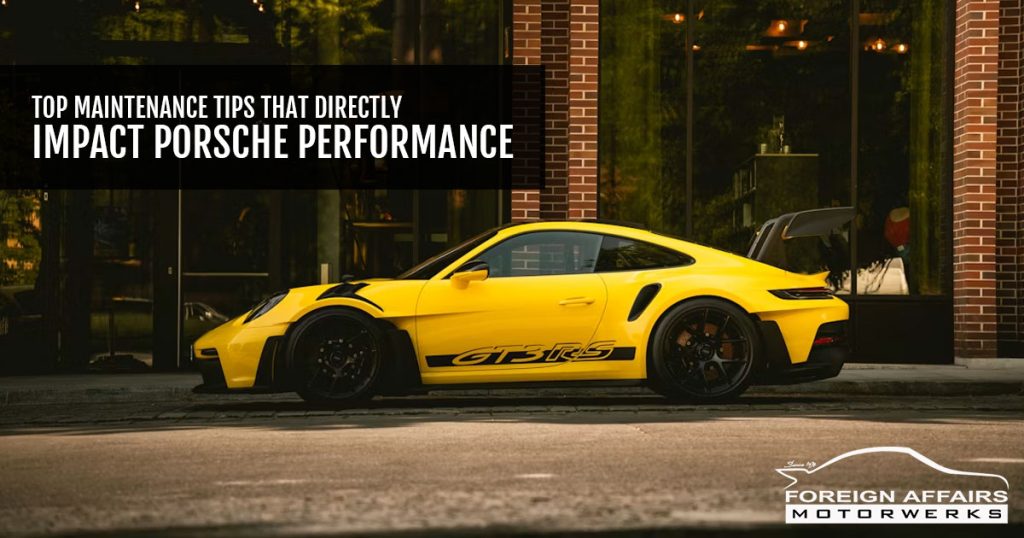
Ensuring that your Porsche continues to perform at its best demands a commitment to detailed maintenance methods. These engineering masterpieces are built to provide you with the ultimate thrill, but your Porsche’s performance can dwindle when specialized maintenance is lacking. In the article, we provide the top maintenance tips that have a direct impact on Porsche performance. Prioritize these maintenance checks, and you’ll be enjoying that Porsche level of performance for years to come.

Be Proactive With Oil Changes
Oil quality plays a significant role in determining engine performance. But more than just getting an oil top-off, the quality of your oil needs to be professionally monitored. Over time, engine oil loses its viscosity, or its thickness. When an engine oil thins out, it loses its effectiveness to protect your engine from friction damage. Although your engine oil level might be full, the quality of your oil could be harming your engine.
A high viscosity synthetic oil is also key to ensuring an optimal engine temperature that drives performance. Thinner oil is less heat-resistant, leading to higher-than-optimal engine temperatures and curbed performance.
Entrusting your engine oil management to a reputable Porsche mechanic provides several advantages, including:
- Your Porsche will receive the performance-grade synthetic oil.
- Never miss an oil change interval with preventative maintenance schedules.
- Ongoing engine inspections to check for oil leaks.
- Remove the risk of engine damage due to low oil viscosity.
Preserve Your Transmission
Porsche’s standard PDK, or Porsche Doppelkupplung dual-clutch transmission, should be serviced in line with your driving style and frequency. If you enjoy pushing your Porsche hard on the track over weekends, it’s advisable to service your transmission every 30,000 to 40,000 miles. For casual Porsche drivers, transmission service intervals should be between every 40,000 and 60,000 miles. Apart from a smooth-shifting transmission, investing in a transmission service is a small price to pay when compared to the associated costs that come with a transmission failure.
Ensure Comprehensive Brake Servicing
Whether you have a Porsche Surface Coated Brake (PSCB) system or Porsche’s Ceramic Composite Brakes (PCCB), your high-performance braking system thrives with ongoing maintenance. A comprehensive brake service includes brake pad replacement, brake rotor and caliper maintenance, and brake fluid management. One of the most common symptoms of rotor warping is if your steering wheel shudders when you brake. Experienced Porsche technicians will carefully check your brake rotors for any signs of warping or cracking. Brake pressure levels are also carefully checked to ensure your calipers and brake cables aren’t leaking.
Observe Intermediate Filter Replacements
Every Porsche is fitted with several high-performance filters. When it comes to air filters, all modern Porsche models require eco-friendly paper cartridge filters, which are designed to filter synthetic oil. Performance paper air filters offer high-efficiency filtering for maximum performance. Regarding maintenance scheduling, your air filter should be replaced every 12,000 to 15,000 miles. Failing to replace your air filter at this recommended interval could result in engine misfiring, non-responsive acceleration, and poorer fuel economy. Your Porsche mechanic will also change out your oil filter, fuel filter, and cabin air filter on recommended manufacturer intervals.
Change Out Your Spark Plugs
Old spark plugs are a major contributor to engine misfires and idling issues, with the Porsche 718 Boxster and Cayman experiencing several early spark tube seal failures. Although it’s possible to remove carbon build-up from spark plugs, for optimal performance, it’s recommended to replace them entirely. Trusted Porsche performance facilities will always use high-performance spark plug brands such as Bosch or NGK.
Refresh Your Coolant
Coolant is responsible for regulating your Porsche engine temperature and preventing it from overheating. Coolant levels need to be consistently checked and topped up to ensure optimal Porsche performance. It’s recommended to do a coolant flush every 30,000 miles to protect against old and ineffective coolant circulating around your engine. A Porsche mechanic will also check for any coolant leaks while also inspecting your radiator for any signs of corrosion.
Prioritize Electric System Checks
Certain Porsche models are susceptible to various electronic malfunctions. A preventative Porsche maintenance schedule will ensure that electrical issues are identified during each service; however, if you notice any of these electrical symptoms while driving, be sure to take your Porsche to a performance facility.
- A faulty ignition switch
- PCM (Porsche Communication Management) failures
- Instrument cluster Issues
- Parking sensor malfunctions
- Air suspension electrical issues
- Key fob failure
- Battery drain issues
How To Protect Your Battery Health
Battery health is a common issue faced by many Porsche drivers. To prolong your battery’s lifespan, be sure to keep your battery terminals clean from corrosion. If your Porsche sits parked for days, it’s worth investing in a trickle charge to prevent your battery from draining. Your trusted Porsche mechanic will be able to advise you further on the best battery maintenance protocols.
South Florida Porsche Performance Professionals
At Foreign Affairs Motorsports, we specialize in Porsche maintenance and performance tuning services. As a full Porsche vehicle lineup facility in South Florida, we service all Porsches, from the classic 911 Carrera to the Macan Turbo S. Guided by Porsche Cars North America, our experienced team provides specialist diagnostic services for those hard-to-find intermittent performance issues.
Call our world-class Pompano Beach workshop today at 954-746-0488 to book your Porsche in for performance maintenance.