


Porsche Repair Shop Checklist: Essential Services For 2026
- Why a Porsche-Specific Repair Checklist Matters
- Routine Maintenance Every Porsche Owner Should Expect
- Engine and Transmission Services
- Diagnostic Technology and Software Updates
- Suspension and Steering Checks
- Battery and Electrical Systems
- Body and Paint Services
- Performance Upgrades and Tuning Options
- Finding A Certified Porsche Repair Shop
- South Florida’s Premier Porsche Service Facility
2026 is gearing up to be a year of new automotive developments, with Porsche perfectly positioned to continue offering performance and digital advancements to their lineup. Prioritizing your Porsche’s maintenance schedule will ensure you continue to enjoy the best in performance and enjoyment from your Porsche. Here’s our Porsche repair shop checklist to keep you up to date with all the essential services for 2026.
Why a Porsche-Specific Repair Checklist Matters
Unlike mass-market vehicles, every Porsche is uniquely engineered to mechanical and electronic perfection. Services are specialized to cater to your Porsche’s specific requirements. Developing a checklist will ensure that you’re keeping up with evolving technology and model-specific maintenance needs. Instead of guessing what your Porsche’s upcoming servicing requirements are, you’ll have a methodical and detailed checklist to follow. A checklist also makes sure that your warranty is protected while guaranteeing optimal performance on the road.
Routine Maintenance Every Porsche Owner Should Expect
Your Porsche’s routine maintenance protocol is a lot more detailed than just taking it for an oil change. Routine maintenance services include minor services (Every 10,000 miles) and major services, which vary between every 20,000 and 40,000 miles, model-specific. Your routine maintenance checklist will include these items.
Oil Changes
Consistent oil changes are important as oil loses its viscosity over time, reducing its effectiveness to lubricate and protect your engine. A professional Porsche repair facility will use performance-grade synthetic oil and an OEM filter replacement.
Fluid Checks
There are several fluid checks to perform, including coolant levels, brake fluid, and power steering fluid. These inspections can occur annually, every two years, or based on mileage. Porsche models with a PDK transmission will typically only require a transmission change every 12 years or 120,000 miles.
Air and Cabin Filter Change
Your air filter ensures that your engine is receiving clean air that is free of debris and pollutants, which is why it’s important to change it regularly. Cabin filters should also be changed regularly to ensure the best quality breathing air for passengers.
Brake System Inspection and Servicing
All Porsches are fitted with performance braking systems that work continually to ensure your safety. Over time, brake components can wear down, requiring servicing and replacement. Your brake pads require frequent inspections and will need to be replaced if your brake pads are worn down to approximately 10 mm or less. Rotors are more hard-wearing and should last for between 50,000 and 70,000 miles. Models fitted with Porsche Ceramic Composite Brakes have rotors that are designed to last up to 100,000 miles, increasing longevity. Your Porsche repair shop will periodically check for warping on your rotors, as this can lead to shuddering when braking. Your Porsche’s brake sensors and brake lines will also be routinely checked to ensure optimal functioning and no leaking.
Tire and Wheel Care
Wheels are subjected to various road conditions that can lead to unique wear patterns developing. The high-performance nature of many Porsches can lead to advanced inner shoulder wear from an uneven camber and outer edge wear caused by aggressive cornering. Your certified Porsche mechanic will check the overall condition of your tires, including tire pressure, correct balancing, and a wheel alignment check.
Ensuring that all these factors are correct will help prolong the lifespan of your tires. Your wheels will also undergo a periodical visual inspection, and any buckling will be picked up during the test drive.
Engine and Transmission Services
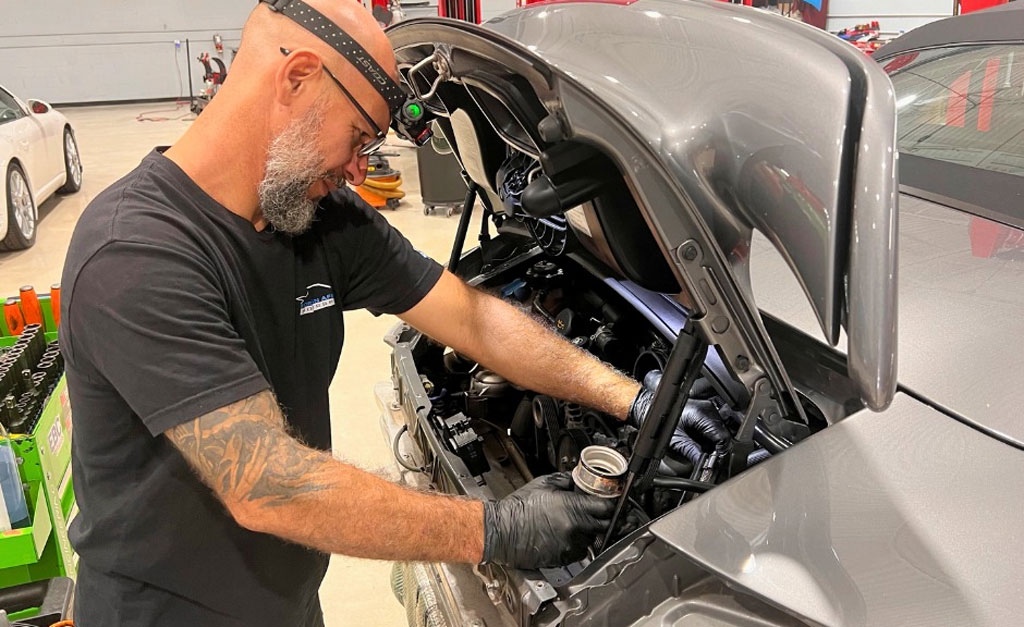
For direct fuel injection engines, it’s important to check for carbon build-up, which will need to be cleaned out by your mechanic. Potential high-pressure fuel pump issues will also be checked for to ensure optimal performance.
For turbo Porsche engines, the emphasis is on preventative maintenance, which includes:
- Regular oil changes
- Only using high-quality oil
- Regular filter cleans
- Protective driving habits such as warming up and cool-down routines
Porsche PDK dual-clutch transmissions also require ongoing maintenance, including specialized fluid and filter changes to ensure longevity.
Diagnostic Technology and Software Updates
More recent Porsche models require the latest version of the PIWIS (Porsche Integrated Workshop Information System) to detect several important aspects, including:
- Advanced fault code detection
- New module programming for components such as suspension and ECU programming.
- Advances systems calibration, including Lane Keep Assist and Adaptive Cruise Control.
- The latest software updates for PCM systems
Be sure to entrust your vehicle to a Porsche auto repair facility that utilizes the latest PIWIS software.
Suspension and Steering Checks
Your Porsche’s suspension system ensures precise handling under various road conditions and driving styles. It’s fitted with Porsche Active Suspension Management and Porsche Dynamic Chassis Control will undergo routine suspension system checks on both systems. Air suspension systems will undergo compression and leak checks before being calibrated for optimum performance.
Battery and Electrical Systems
All Porsche electric systems and battery modules should be thoroughly inspected. Lithium-ion will be checked for any signs of corrosion and battery drain. Electric and hybrid models, such as the Porsche Taycan, will undergo intensive battery checks and coolant level checks, as they rely heavily on battery power. Your trusted Porsche repair shop should also be able to advise you on the best driving habits to protect and prolong the life of your battery.
Body and Paint Services
Your Porsche’s body will be checked for paint imperfections, corrosion, minor dents, and chips. Drainage points, including your sunroof and body drains, will be checked and cleaned. Your repair facility’s paint specialist will advise you on any corrective work that may need to be done.

Performance Upgrades and Tuning Options
Reputable auto repair and performance facilities will offer some exciting Porsche performance upgrade options for enthusiasts, including:
- ECU remapping
- Adding a turbocharger and supercharger
- Performance exhausts and wheels
- Performance air intakes
Finding A Certified Porsche Repair Shop
Certification and experience are key considerations when choosing the right Porsche repair shop. Be sure to check that your facility is ASE certified. The National Institute for Automotive Service Excellence tests and certifies automotive professionals to improve the quality of repair work. An ASE-certified facility means that the technicians working on your car possess a high level of technical knowledge and skill. Choosing a repair shop that carries vast experience on all Porsche models will ensure that your Porsche is treated with a discerning eye that is able to troubleshoot and identify any potential issue.
South Florida’s Premier Porsche Service Facility
At Foreign Affairs Motorsports, we’re proud to be a full-service Porsche vehicle lineup service facility. As an ASE-certified facility, we offer specialized Porsche maintenance on all levels. Our preventative maintenance opackages will ensure that your Porsche follows a rigorous checklist, offering the best Porsche servicing in South Florida.
Call our world-class Pompano Beach facility at 954-746-0488 to book your service appointment today.